From poet to public leader
Her political life did not begin with a conversion. It accumulated — through famine and plague relief work, through the constitutional politics of the 1910s, through Gandhi’s arrival as the organising force of the Congress, and through her own steady discovery that a platform was something she could command.
How to read this pageThe page darkens as it descends, from the constitutional politics of the 1900s into the mass movements of the 1930s. The change of ground is deliberate.
1900s – 1914
Relief work, reform politics, and a reputation
Her entry into public life came through social work rather than party politics. She spoke and organised on famine and epidemic relief, on education, and on the position of women — the recognised routes by which a woman of her class could act publicly in early twentieth-century India.
In 1911 she was awarded the Kaisar-i-Hind Medal, a British honour given for public service in India, for relief work. She was, at that point, a figure the imperial state was willing to decorate.
Alongside this she was drawn into the constitutional nationalism of the period, and into the orbit of Gopal Krishna Gokhale, the Congress moderate who argued for reform through representation. She met M. K. Gandhi in London in 1914, shortly before he returned to India for good.
- 1911
- Awarded the Kaisar-i-Hind Medal for relief work
- 1914
- Meets M. K. Gandhi in London
- 1917
- Leads a deputation of Indian women on the franchise, 15 December
- 1918
- Publishes Muhammad Jinnah: An Ambassador of Unity, a short study arguing for Hindu–Muslim political co-operation
- 1919
- Returns the Kaisar-i-Hind Medal after the Jallianwala Bagh massacre; travels to England with a Home Rule deputation
- 1925
- Elected President of the Indian National Congress, Kanpur session
- 1931
- Second Round Table Conference, London
1919 – 1930
The turn
The Rowlatt Act of 1919 and the massacre at Jallianwala Bagh in April of that year ended the possibility, for a great many Indians of her generation, of working within the imperial framework. She returned her medal.
From that point her political work changed character. She moved from petition and deputation into Gandhi’s mass movements: non-co-operation, the boycott of foreign cloth, civil disobedience. She travelled continuously, speaking at Congress sessions, student meetings and public gatherings, and she began to be arrested.
This is the shift the simple version of her story compresses into a sentence. It took roughly a decade, and it cost her the position of a decorated public servant.
A documented political association
Gandhi and Sarojini Naidu
They met in London in 1914 and worked together for the next three decades — in the Congress, on campaigns, at conferences, and in prison. What follows is what the record supports. No private conversation between them is invented here.

Their association is unusually well attested for the period, because so much of it happened in public: shared platforms, shared committees, shared arrests.
She was among the Congress leaders closest to him during the civil disobedience years, took over the Dharasana action after his arrest in 1930, accompanied him to London in 1931, and was detained with him after the Quit India resolution of 1942.
She was also, by many contemporary accounts, one of the few people in that circle who teased him in public. Affectionate anecdotes on this subject circulate widely and are rarely sourced; this site leaves them where it found them.
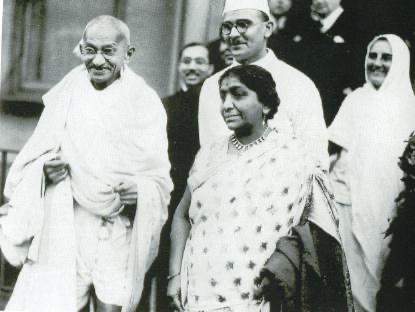
Photographed during the period of the Second Round Table Conference, at which she was the only Indian woman in the Congress delegation.
London, 1931
The Second Round Table Conference followed the Gandhi–Irwin Pact and was intended to settle the constitutional future of India. It did not. Congress had boycotted the first conference; the third produced no agreement it would accept.
Her presence there matters less as a negotiating achievement than as a fact about representation. The Indian National Congress sent a delegation to argue for self-government at a British conference, and one of the people it sent to speak for India was a woman.
Kanpur session
President of the Indian National Congress
In 1925 the Indian National Congress met at Kanpur and elected Sarojini Naidu its president. She was the first Indian woman to hold the office.
The precision matters. Annie Besant, born in London and long resident in India, had presided over the Calcutta session in 1917. Sarojini Naidu was the first Indian woman — and, for a long time afterwards, one of very few women in the Congress leadership at all.
What the office was
The Congress presidency rotated annually and was, in practice, a chairing role: presiding over the session, delivering the presidential address, and representing the organisation for the year. Real continuity of power sat with the Working Committee and, increasingly through the 1920s and 1930s, with Gandhi’s personal authority. The presidency was a position of standing rather than command.
What it changed
It made the presence of a woman at the head of the national movement a settled fact rather than a proposal. Women had been active in the Congress for years; a woman presiding over its annual session placed that activity at the centre of the photograph. For a movement that argued its case partly through public spectacle, that was not a small thing.
What it did not change
It did not open the Congress leadership to women generally. Decades passed before another Indian woman presided. Nor did it settle the argument, running through Indian politics in these years, about whether women’s demands should wait until independence had been won. Treating 1925 purely as a symbolic victory flattens a more difficult record.
A commitment she held throughout
Arguing for Hindu–Muslim political unity
In 1918 she published a short study of Muhammad Ali Jinnah under the title Muhammad Jinnah: An Ambassador of Unity. At that date Jinnah was a leading constitutional nationalist working across both the Congress and the Muslim League, and the description was an accurate one.
The poem ‘Awake!’, in The Broken Wing of 1917, is addressed to him. The two documents belong together, and both belong to a period before the political separation that followed.
Communal unity remained one of her consistent public themes for the rest of her life — through the 1920s, through the constitutional negotiations of the 1930s, and into the partition years, when she held office in a province receiving refugees in very large numbers.
On quotationsSarojini Naidu is one of the most misquoted figures in Indian public memory. Lines circulate under her name that appear in no published speech or text. Nothing is attributed to her on this site unless it can be traced to a published work, and poetry excerpts always carry their collection and year.