1879
Born in Hyderabad
Born 13 February to Aghorenath Chattopadhyay, principal of Nizam College, and Barada Sundari Devi, who wrote poetry in Bengali.
The many voices of Sarojini — a literary and historical archive
Poet • Orator • Nationalist • Leader

§ 01 — Two lives in one life
Sarojini Naidu published her first collection of verse in London in 1905 and was elected President of the Indian National Congress twenty years later. It is tempting to read that as a straight line — the poet who grew up into a politician. The record does not support it.
Her literary reputation and her political work ran alongside each other, not one after the other. The Broken Wing appeared in 1917, the same year she led a deputation of Indian women to the Secretary of State for India to argue for the vote. She was still being reviewed as a lyric poet in London while she was organising in Bombay and Hyderabad.
What poetry gave her was not a political programme. It gave her an audience, a public name, and a command of English prosody that made her one of the most effective speakers of her generation on a public platform. Poetry did not cause her politics. It equipped them.
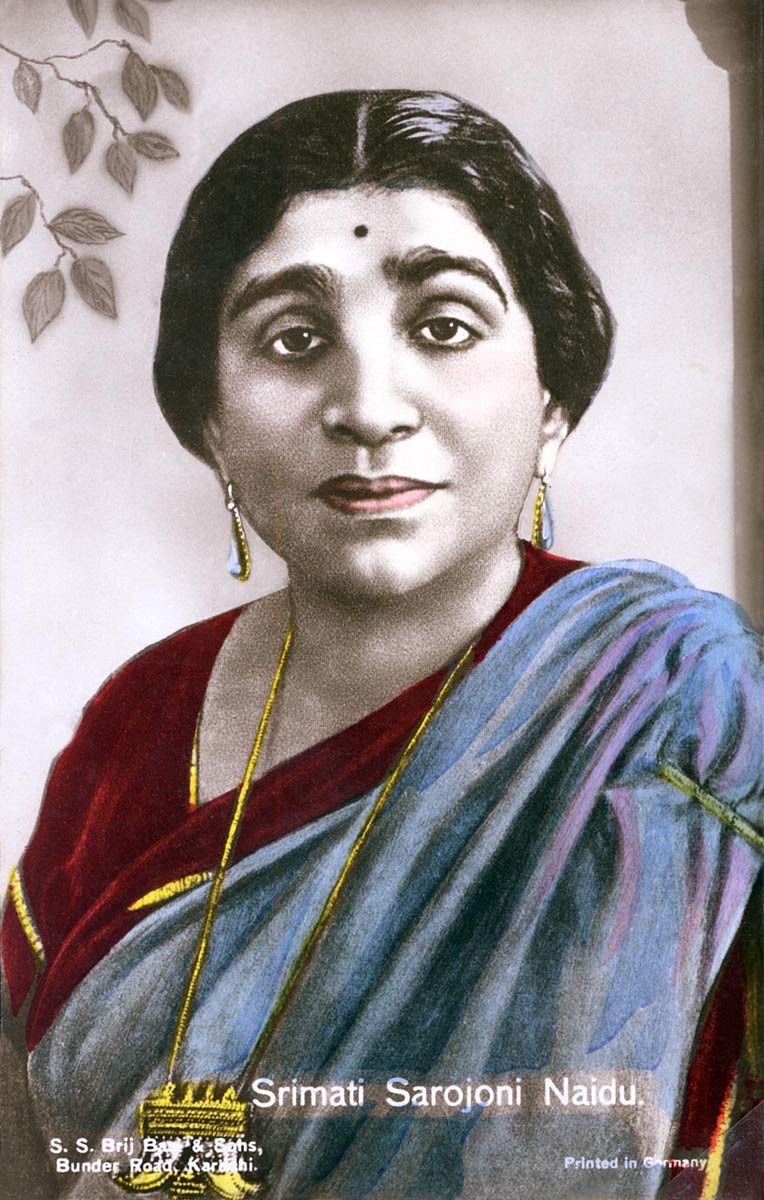
Printed portrait cards of this kind circulated widely in early twentieth-century India. Their existence is itself evidence: by this point her face, not only her verse, was public property.
§ 02 — The many voices
Five public identities, held at the same time. Choose one from the panel on this page and the site re-tunes itself around it — nothing is hidden, only brought forward.
Three collections — The Golden Threshold (1905), The Bird of Time (1912) and The Broken Wing (1917) — published in London and New York, introduced by Arthur Symons and Edmund Gosse. Palanquin bearers, bangle sellers, weavers, the bazaars of Hyderabad: she wrote Indian material in English metre for a readership that had rarely been offered either.
Contemporaries who disagreed with her politics agreed about her speaking. She addressed student gatherings, Congress sessions, women’s conferences and public meetings across India, and audiences in Britain, South Africa and the United States. In a movement that depended on mass persuasion rather than mass force, the ability to hold a crowd was not decoration. It was infrastructure.
She joined the Non-Co-operation movement after 1919, returned a British honour in protest at the Jallianwala Bagh massacre, and on 21 May 1930 led the satyagraha at the Dharasana Salt Works after Gandhi’s arrest — an action reported worldwide. She was imprisoned repeatedly, and detained for roughly twenty-one months after the Quit India resolution of 1942.
On 15 December 1917 she led a deputation of Indian women to Edwin Montagu, Secretary of State for India, and Lord Chelmsford, the Viceroy, asking that the coming franchise reforms be written without regard to sex. She did not do this alone — she worked inside a wide network of women organisers — and the demand was not granted in 1919. Both facts matter.
On 15 August 1947 she was sworn in as Governor of the United Provinces — the first woman to hold a governorship in India. The office she now occupied was, in constitutional form, the same one she had spent decades resisting. She held it for less than nineteen months, until her death at Government House, Lucknow, on 2 March 1949.
The simplest account of Sarojini Naidu — poet becomes patriot — survives because it is easy to teach. The harder account is more interesting.
She was a Bengali woman raised in a Hyderabad household unusually committed to education, sent to England at sixteen, and told by English critics to stop imitating English poets and write India instead. She took that advice, and it made her famous in two countries at once.
That fame is what she then spent. It bought her a hearing in rooms where Indian women had no standing: Congress committees, viceregal deputations, London conferences. She used it to argue for self-rule, for the franchise, for Hindu–Muslim political unity, and for the presence of women in public life as a matter of right rather than permission.
She was not a systematic political thinker and did not claim to be. She was something the movement needed at least as much: a persuader with a national reputation, willing to be arrested.
§ 03 — The historical journey
1879
Born 13 February to Aghorenath Chattopadhyay, principal of Nizam College, and Barada Sundari Devi, who wrote poetry in Bengali.
1891
Passes the University of Madras matriculation examination at the head of the list, aged twelve.
1895
Travels to England on a scholarship supported by the Nizam of Hyderabad; studies at King’s College London and Girton College, Cambridge, leaving without a degree in 1898.
1898
Marries Dr Govindarajulu Naidu, a physician. The marriage crossed caste lines and was made with her father’s support.
1905
Her first collection is published in London with an introduction by the critic Arthur Symons.
1917
The Broken Wing appears. On 15 December she leads a deputation of Indian women to Montagu and Chelmsford to demand that women be enfranchised under the coming reforms.
1919
She returns the Kaisar-i-Hind Medal, awarded to her in 1911 for relief work, in protest at the Jallianwala Bagh massacre, and moves into full non-co-operation.
1925
Elected President of the Indian National Congress at the Kanpur session — the first Indian woman to hold the office.
1930
On 21 May she leads the salt satyagraha at the Dharasana Salt Works after Gandhi’s arrest. The beatings that follow are reported around the world by the journalist Webb Miller.
1931
Accompanies Gandhi to the Second Round Table Conference in London, the only Indian woman in the Congress delegation.
1942
Arrested with Gandhi after the Quit India resolution and detained for roughly twenty-one months, largely at the Aga Khan Palace in Pune.
March 1947
Presides over the Asian Relations Conference in New Delhi, 23 March – 2 April, months before independence.
August 1947
Sworn in on 15 August as Governor of the United Provinces — India’s first woman governor.
1949
Dies in office at Government House, Lucknow, on 2 March, aged seventy.
§ 04 — Words that travelled
All three collections appeared in London while she was building a political life in India. Each is now long out of copyright, and each is still in print.
Her first collection, and the one that fixed her English reputation. It gathers the folk-song poems most often anthologised — palanquin bearers, weavers, fishers on the Coromandel coast — written in strict English metre about entirely Indian subjects.
A darker book than the first. Gosse’s preface tells the story he had told her privately years earlier: that she should stop writing like an English poet and write as an Indian one. The collection reads as the result.
The most political of the three, published in the year of the franchise deputation. It contains ‘The Gift of India’, her poem on Indian soldiers who died in the First World War, and ‘Awake!’, addressed to Muhammad Ali Jinnah.
Lightly, O lightly we bear her along,
Opening lines of ‘Palanquin Bearers’, The Golden Threshold, 1905 — now in the public domain
She sways like a flower in the wind of our song;
On quoting herShort excerpts from her published verse appear across this site, always with the collection and year attached. Sayings widely circulated online under her name without a source are not reproduced here.
§ 05 — Afterwards
Explore her life, her writing and her public leadership — ten sections, built from documented record.