A voice in the struggle
Between 1919 and 1943 Sarojini Naidu moved through every major phase of the Indian national movement — non-co-operation, civil disobedience, the salt campaign, Quit India — and was imprisoned repeatedly for it. This page sets out what she did, without inflating it.
For younger readersThis page describes political imprisonment and, in one section, a violent episode reported by an eyewitness journalist. It is written plainly and without graphic detail.
The ground
What she was taking part in
Four things need to be clear before the chronology makes sense.
British rule
Most of India was governed directly by Britain; the rest, like Hyderabad where she was born, was ruled by Indian princes under British paramountcy. Indians had almost no say in the laws that governed them, and the reforms offered between 1909 and 1935 widened participation only slowly and partially.
The Indian National Congress
Founded in 1885, initially a body of professionals petitioning for reform. After 1920, under Gandhi’s influence, it became a mass organisation with a membership across the country and a method based on non-violent mass action.
Satyagraha
Gandhi’s method: break an unjust law deliberately and openly, accept arrest, and refuse to retaliate. Its force came from the contrast between the discipline of the protesters and the response of the state — which meant it depended on that response being witnessed and reported.
Prison as a normal condition
For Congress leaders in these decades, imprisonment was routine rather than exceptional. Sarojini Naidu was jailed in connection with the civil disobedience campaigns of 1930 and 1932 and detained for roughly twenty-one months after 1942. Being willing to be arrested was, in practice, a qualification for leadership.
Documented participation
Twenty-four years, campaign by campaign
- 1919
After the Rowlatt Act and the Jallianwala Bagh massacre she returns the Kaisar-i-Hind Medal awarded to her in 1911, and travels to England as part of a Home Rule deputation. She moves into Gandhi’s non-co-operation programme.
- 1920s
Congress organising, the boycott of foreign cloth, and continuous public speaking. In 1924 she travels to South Africa in connection with the position of the Indian community there. In 1925 she presides over the Congress at Kanpur.
- 1930
The Salt Satyagraha. Gandhi’s march to Dandi in March and April breaks the salt law. Women’s participation in the march itself was initially restricted, and was argued for. Sarojini Naidu takes part in the campaign and is arrested; after Gandhi’s arrest in early May she becomes one of its leaders.
- 21 May 1930
Dharasana. She leads the satyagraha at the Dharasana Salt Works in Gujarat. See the section below.
- 1931
Accompanies Gandhi to the Second Round Table Conference in London as the only Indian woman in the Congress delegation. The conference ends without agreement.
- 1932
Imprisoned again as civil disobedience resumes after the failure of the Round Table process.
- 1942–43
Quit India. The Congress passes the Quit India resolution on 8 August 1942 and its leadership is arrested at once. She is detained with Gandhi for roughly twenty-one months, largely at the Aga Khan Palace in Pune, where Kasturba Gandhi and Mahadev Desai both died in detention.
- 1946
Elected to the Constituent Assembly, representing Bihar — the body that would frame the Constitution of independent India.
21 May 1930
Dharasana
The plan was Gandhi’s: a mass raid on the government salt works at Dharasana, on the Gujarat coast. He was arrested in early May, before it could take place. The action went ahead without him.
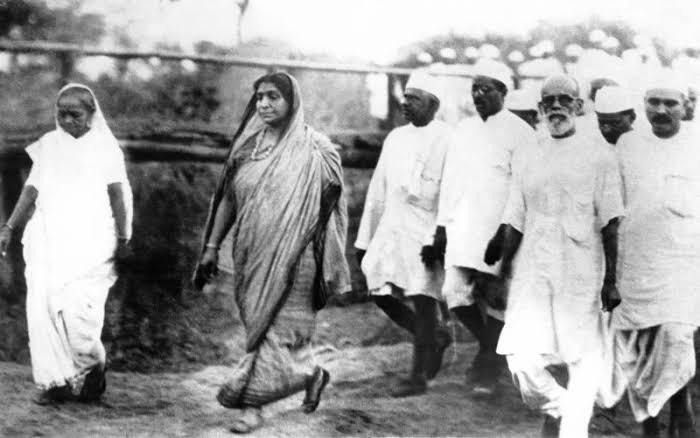
Sarojini Naidu was among its leaders. Volunteers advanced in columns towards the barbed wire around the salt pans. They were beaten back by police and did not resist. Column after column advanced and was beaten in turn.
Her instruction to the volunteers, recorded by those present, was that they must not use violence under any circumstances, and must not raise a hand to defend themselves.
She was arrested. The American journalist Webb Miller of United Press was present and filed an account of what he saw — two deaths and more than three hundred injured. British telegraph operators delayed the dispatch, but it was published in over a thousand newspapers and read into the record of the United States Senate.
Why it matteredDharasana produced no immediate political concession. What it produced was evidence, carried by a foreign correspondent to an international readership, of what the salt monopoly was being defended with. Satyagraha was designed to generate precisely that, and this is the clearest instance of it working.
1942 – 1943
Quit India, and twenty-one months
On 8 August 1942 the Congress demanded an immediate British withdrawal from India. Within hours its leadership was arrested across the country.
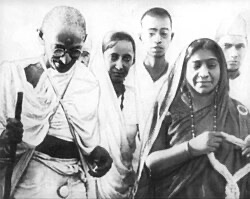
Sarojini Naidu was detained with Gandhi and held for roughly twenty-one months, largely at the Aga Khan Palace in Pune. It was a long confinement for a woman then in her sixties and in poor health, and two of those detained alongside her — Kasturba Gandhi and Mahadev Desai — died during it.
She was by this point among the senior figures of the movement, thirty years into public life. The independence she had spent that time arguing for arrived four years after her release, and she lived under it for nineteen months.
Keeping her role in proportion
Sarojini Naidu was not a strategist of the national movement in the way that Gandhi, Nehru, Patel or Azad were. She did not build the Congress machine, draft its programmes or run its negotiations.
What she did was distinct and documented: she led one of its most consequential single actions, she carried its argument to audiences in three continents, she was one of the very few women in its senior leadership for two decades, and she went to prison for it more than once.
Claiming more than that does her no favours. The record is substantial enough without decoration.
SourcesThe chronology on this page follows standard reference accounts of the Indian national movement and of Sarojini Naidu’s life. Where dates or roles are disputed between accounts, the disagreement is stated rather than resolved.