After the poem ends
Seventy-five years after her death Sarojini Naidu is taught in Indian schools, quoted on the internet, printed on commemorative stamps and attached to hospitals, colleges and roads. Almost none of that remembers the same person.

The argument for reading her now
Why Sarojini Naidu still matters
Women in politics
She is the standing counter-example to the idea that women entered Indian public life only after independence. She presided over the national movement’s annual session in 1925, led a franchise deputation in 1917, and held constitutional office in 1947. The question her career raises is not whether women were present but why so few were, for so long, after her.
The role of public speech
Her central political instrument was the spoken word in front of a crowd. In an era of mass movements without mass media, that capacity was strategic infrastructure. It is also the part of her legacy that has survived worst, because speeches leave thinner traces than books.
Literature and nationalism
She is a case study in what it meant to write a colonised country in the coloniser’s language and forms, for readers in the imperial capital. Every reading of that project — as self-assertion, as accommodation, as both — is still being argued, and the argument is more interesting than the verdict.
Leadership after independence
Her nineteen months as governor are a compressed example of a problem every successful independence movement faces: the people who were best at opposing a state must now operate one. She met that problem in the worst possible circumstances, during partition, and the record of it is more instructive than a celebration would be.
Memory and myth
She is one of the most affectionately misremembered figures in Indian public life. Understanding how a complicated political career becomes a warm, quotable, uncontroversial figure is worth doing for its own sake — and it is the subject of the section below.
The poems themselves
Independently of all of the above, the poems are still read. ‘Palanquin Bearers’, ‘In the Bazaars of Hyderabad’ and ‘The Gift of India’ remain among the most widely taught English poems in India. Whatever else is argued about her, that readership is a fact.
Memory & myth
The historical figure and the simplified one
The popular Sarojini Naidu is a nightingale: gentle, lyrical, patriotic, endlessly quotable. The documented one is harder, more specific and more interesting.
The simplified figure
- “The poet who became a freedom fighter” — a conversion narrative.
- Named “the Nightingale of India” by Gandhi — repeated everywhere, sourced almost nowhere.
- Leader of the Indian women’s movement.
- Governor of Uttar Pradesh.
- The author of many inspirational sayings shared under her name.
- A warm, uncontroversial national symbol.
What the record supports
- Poetry and politics ran in parallel from at least 1905 to 1917, not in sequence.
- The name is popularly attributed to Gandhi. The attribution is traditional; it is not documented here as fact.
- One prominent figure inside a network that included Annie Besant, Margaret Cousins, Herabai Tata and Muthulakshmi Reddy.
- Governor of the United Provinces. The province was renamed Uttar Pradesh in 1950, after her death.
- Her verifiable words are in three published collections, a study of Jinnah, and reported speeches. Most circulating quotations trace to none of these.
- A political leader who returned a British honour, led a satyagraha that ended in mass injuries, and spent roughly twenty-one months in detention.
Why this section exists None of the entries on the left are malicious. They are what happens when a long, contested career is compressed for a textbook margin or a social media card. The point of setting the columns side by side is not to diminish her, but to show that the documented version needs no help.
Where her name is kept
Institutions and public memory
The Golden Threshold, her house in Hyderabad, takes its name from her first collection. It is now an annexe of the University of Hyderabad and houses the Sarojini Naidu School of Arts & Communication.
Her birthday, 13 February, is observed in India as National Women’s Day.
Institutions carrying her name include the Sarojini Naidu Medical College in Agra and the Sarojini Devi Eye Hospital in Hyderabad. An asteroid discovered in 1990, 5647 Sarojininaidu, was named after her; the naming citation was published in 2019.
Her collections remain in print and out of copyright, and are widely available in free digital editions.
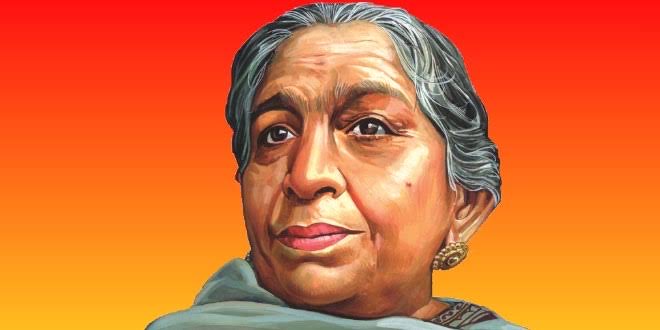
A contemporary illustration of the kind now used on commemorative posts and educational material. It is included here as evidence of how she is currently pictured, not as a historical image.
Method
How this site was written
Principles applied throughout
- Dates, offices and publications are taken from standard reference and encyclopaedic accounts of Sarojini Naidu and of the Indian national movement, and cross-checked between them.
- No quotation is attributed to her unless it can be traced to a published work. Widely circulated unsourced sayings are not reproduced.
- Poetry excerpts are brief, are drawn from collections published in 1905, 1912 and 1917 that are out of copyright, and always carry their collection and year.
- Where accounts disagree — the number of her children, the precise circumstances of her early scholarship — the disagreement is stated rather than resolved.
- Literary and historical interpretation is labelled as interpretation and separated from record.
- Photographs are reproduced whole. Where a surviving print is itself cropped or of low resolution, the caption says so.
- Decorative artwork made for this site is labelled as ornament and never presented as archival.